
A Carvers’ Tail
My Carving Experience in the House of Dreher
"Learning from Patrick has been one of the highest honors of my career."
Ever since I started my studies in gemology, I was always fascinated by the people who were able to make the beautiful treasures I was learning about. At the time as a goldsmith, I couldn’t believe the precision some people were able to achieve working on gemstones. At this point in my career, I didn’t even know how to polish out scratches on a gemstone if you scratched it during the setting process when making jewelry, so I sort of looked at the master cutters of the industry as wizards performing magic tricks.
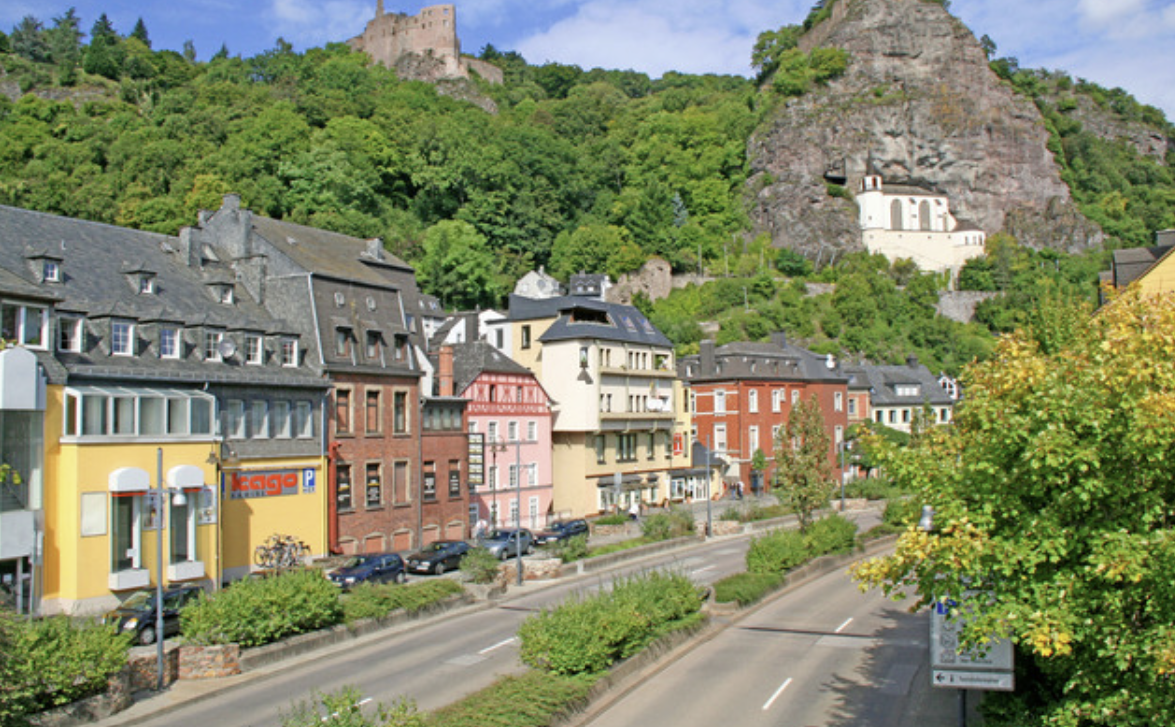
In the courses at GIA, you learn about this legendary town in Germany with a gemstone cutting history older than the country I call home named Idar-Oberstein. From the first glance around town, Idar looks like most other small German towns with one major exception. Gemstone businesses, cutting and carving houses, supply stores, tool makers, etc... are everywhere! It is every gemstone lover’s paradise tucked into a very beautiful valley. With a population hovering around 30.000 people, it’s a wonder this small town is responsible for producing so many of the world’s greatest gemstone treasures.
As a craftsman, I always pay attention to who the maker is, and it was clear to see from my first visit this town was full of master gemstone cutters and carvers of all kinds. People who for generations have been honing their skills in pursuit of perfection. More than the gemstones or anything else, it’s the families of masters like the Drehers, the Paulys, and so many others that make this town so special and a must visit for any jewelry maker or lapidary!
Art can be many things depending on the viewer. I think watching a master of their craft in action no matter what is being made is art. Little did I know in 2021 when I took a special trip to Houston with my best friend and business partner Mary van der Aa just to see the Dreher exhibit at the Houston Museum of Natural Sciences that I would soon meet Patrick and be able to see first-hand how he makes these exquisite treasures.
The first time I saw a Dreher carving when I was a student at GIA, I could not believe what I was looking at! I’m certain most people feel this way the first time they’re introduced to these masterpieces. Walking around a room that had over 150 Dreher carvings on display, representing three generations of carvers, I spent a lot of time that day at HMNS in awe of what I was seeing. I couldn’t believe the minute details, the ultra-realistic proportions, just everything about these masterpieces had me wondering how these things are created. At that point in my life if you asked me what I wanted to be when I grew up, I would have said a gemstone carver like the Drehers!

Kristiane and Patrick Dreher, Mary van der Aa and I enjoying the Deutsches Eck
Fast forward one or two Tucson shows in the future and a chance encounter led to one of the greatest friendships and learning opportunities I have been a part of. The details can be told at a different time but long story short I met Patrick and Kristiane when they stumbled into a faceting demonstration I was doing at the Tucson convention center. The next day Mary and I went to their gallery so we could hopefully get a chance to talk with them more about his work as I had so many questions! With luck on my side being one of the last days of the show, it was quiet in the gallery first thing in the morning, so I was able to talk with Patrick and ask about his work. I don’t know if we were there all that long, maybe an hour or less, but at some point I found myself jokingly offering that I could teach Patrick how to cut gemstones the way I do for jewelry if he taught me how to carve gemstones. Clearly a one-sided offer where Patrick doesn’t get anything out of it that would be remotely close to the value of what he was offering in return so we came to a monetary agreement that worked for him and we shook on it.
I think from the get-go we both had mutual respect for each other’s work, we come from similar backgrounds, and just got along naturally so he was willing to teach me a few things which I am forever grateful for. I’m not sure if he knew I was serious and it would turn into Mary and I coming every April the last few years to learn but it has blossomed into the best of times with a couple of our greatest friends! It is my hope that they don’t get tired of us coming once a year and I can continue learning from Patrick over the years!
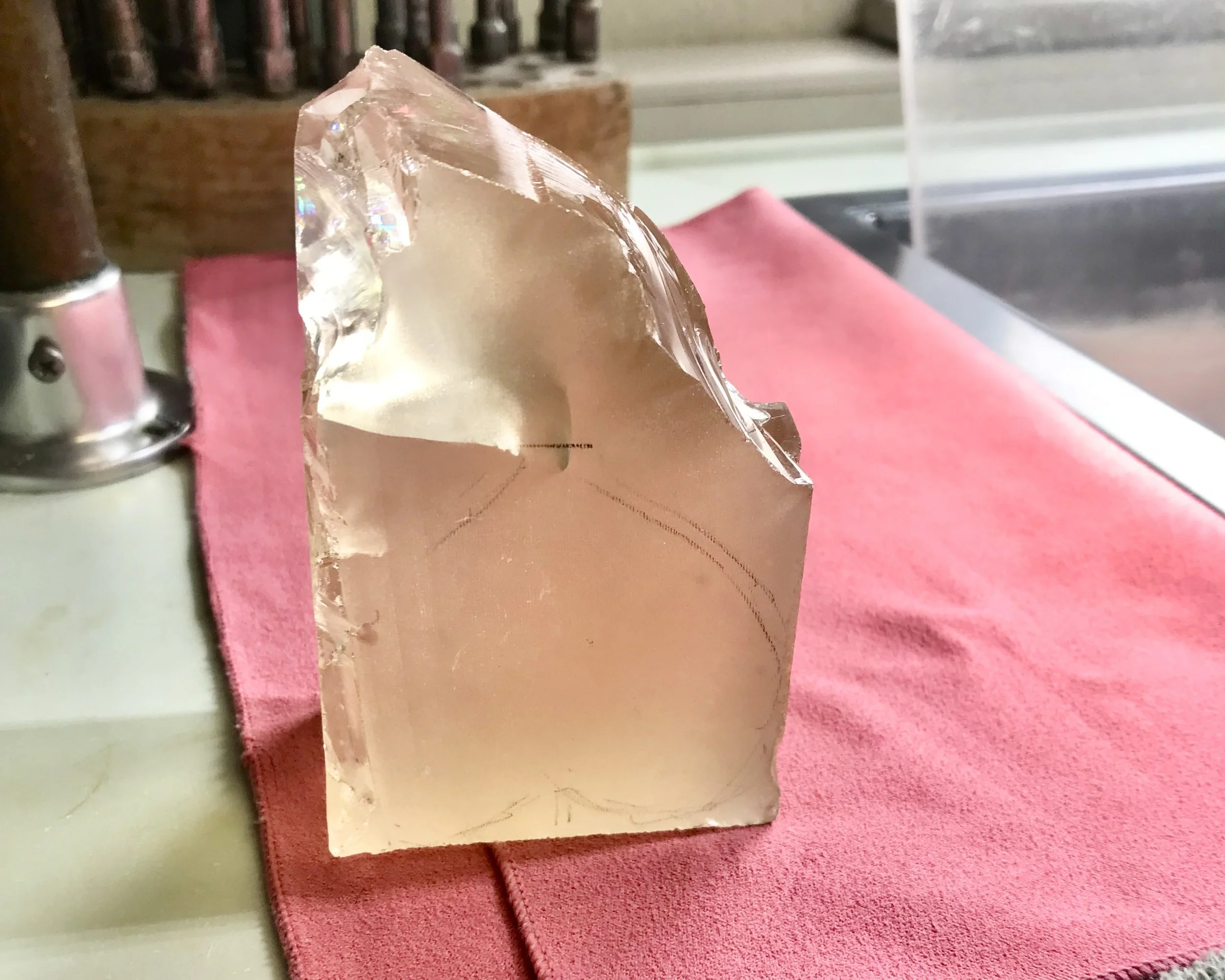
The rough citrine at the start
Few are lucky enough to know the real Patrick, but I promise you he is beyond approachable and 100% worth getting to know in this life. To me he is a mentor, idol, and so many other things but the true gift I have received in all this is his and his soon-to-be wife Kristiane’s genuine friendship. He is a person even more special and rare in this world than the astonishing masterpieces he creates and he luckily found someone just as genuine as himself in Kristiane. Most people only get to see his work life, but he has many passions on the rare occasion he is able to take some time away from work.
Patrick is first and foremost a Kristiane lover, an avid scuba diver, sushi fan, beach bum, model plane maker, Lego building extraordinaire, animal lover, military veteran and historian, hobby chef, traveler, and you can occasionally catch him and Kristiane cruising the sports cars on the autobahn. He may be the most famous master to ever come out of Idar, yet he is a very humble and genuine person worth knowing if you ever get the chance!
I want to express to the viewer a few things by chronicling my experiences in the House of Dreher but the main point is this. Hands down we are witnessing the greatest carver of all-time live-in action. Anyone who is fortunate enough to own one of his carvings is part of a very small group I call “the lucky ones”. If this first statement were to be contested, I would argue that person didn’t see the fire opal fish last Tucson show. It takes nerves of steel to take a six-figure piece of rough gemstone and turn it into a Siamese fighting fish with undulating fins at 2mm thickness in opal. A stone that is so easy to break during the cutting and polishing stages. Nobody else could have done that. I could cite examples all day of his superiority, but that fish put any argument to rest. Gemstone carvings are the height of human craftsmanship colliding with art and Patrick is the greatest to ever do it.
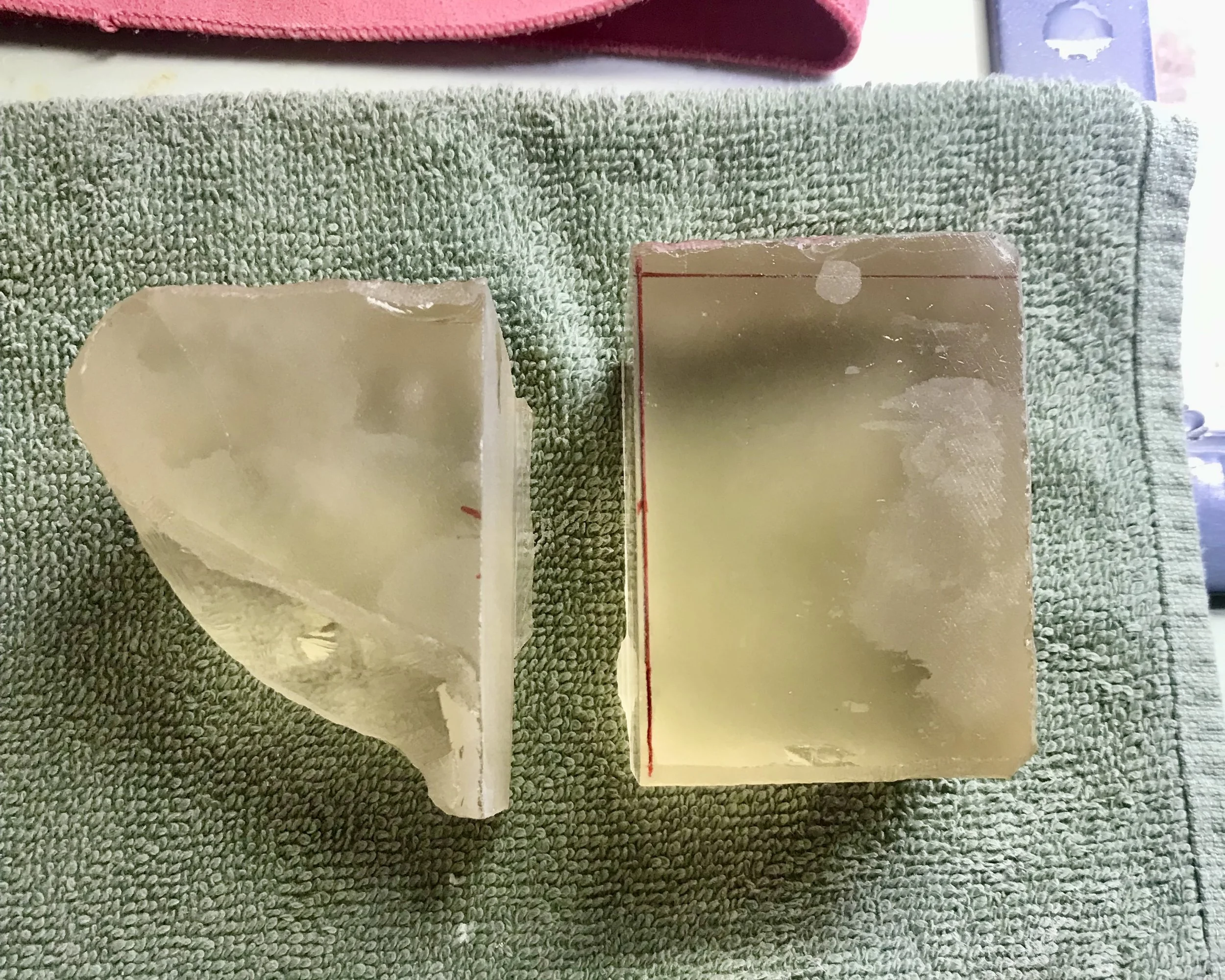
After sawing through the fracture to free the clean working piece
It is my opinion after finishing my first carving under Patrick’s tutelage that to buy a Dreher carving there should be a prerequisite. That prerequisite is you should have to try to carve an animal yourself before you can buy one. The reason is that when anyone gets the chance to view a Dreher carving, it’s easy to see them as amazing, stupendous, awe- inspiring objects of art. You know they’re masterpieces from ten feet away and when you get close to see all the details, you can’t believe what your eyes are seeing. Anyone can see how advanced Patrick’s skills are. Yet it’s only when you try to carve one of these yourself that you truly understand how good Patrick is. You start to look at him like a jedi master rather than a gemstone carver!
For instance, carving the fur was the hardest thing I have ever learned when it comes to lapidary work, and I’m still not good at it. I’m just barely good enough now that what I carve somewhat looks like fur, but I can show you dozens of differences between mine and Patrick’s work. His fur is perfect every time, realistic to the movement of the animal, all hairs going in the correct orientation for the animal, all hairs are carved at the same depth and width, just perfection in the details.
During one of our sessions I was observing Patrick carve fur, asking him questions about how he holds his hands, is there more pressure with his dominant hand, etc.… and he said, “You think too much, just do it.” He was looking at me and talking while his hands were carving fur without him hardly paying attention visually. Here I was failing to complete the task for weeks on end no matter how hard I tried, no matter what I did differently. It just wasn’t clicking yet with my hands. Then you have Patrick who can effortlessly complete the task.
That’s when I realized the skill he possesses to create these masterpieces is something we may never see again on this planet once he retires.
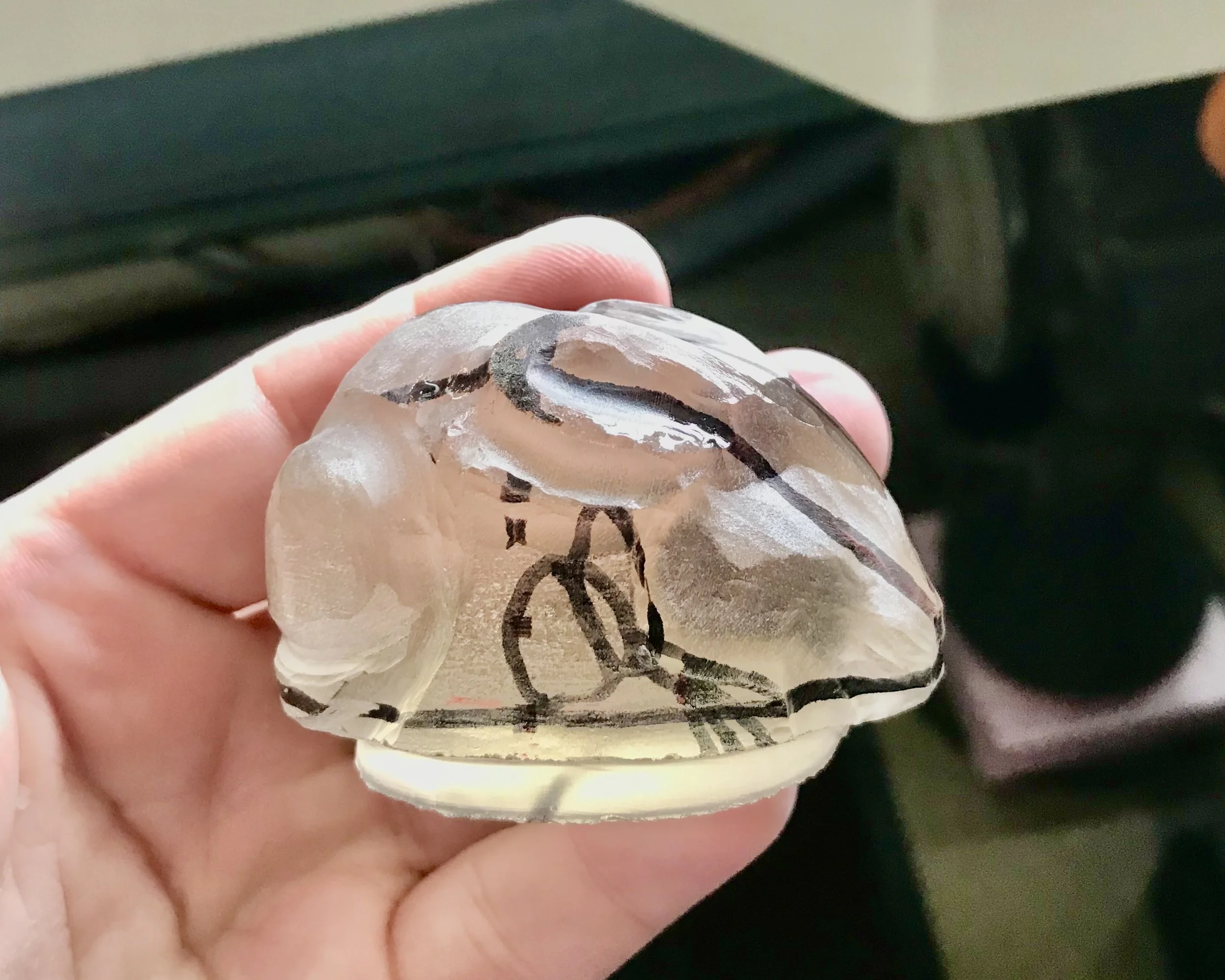
Starting to carve away the excess
So, let’s dive into my experiences learning a little bit from Patrick about his craft. It is my hope that by the end of reading this, the collector has a real understanding of what they are getting when they are lucky enough to be able to own a true piece of lapidary history!
To understand what you’re looking at when viewing a Dreher carving… the legacy, the history, the dedication of over 13 generations to achieve the highest form of gemstone art the world has ever known, I feel we must start at the beginning. It is documented back to the early 1600’s the Dreher family through thirteen generations have been hard stone carvers in Idar-Oberstein, Germany. In German, the word “dreh” means to turn, so a loose English translation of the name Dreher means they are the Turners. The name Dreher came from the skilled wood workers using lathes that were known as turners, or in German the drehers.
For a long time, Patrick’s family made agate bowls, and other objects of art. It was around 5 generations ago his great, great grandfather began carving animals local to the area. They were a family of carvers ahead of their time, yet this was before the days of National Geographic or any idea of what the internet was. The only way they could get the necessary photos to recreate the animals in hard stone was to take photographs for themselves or draw the animals. With only so many animals local to Germany, expanding the legacy into what it is today took serious dedication to one’s craft and a lot of studying animal movement to recreate lifelike features of animals in stone. This required traveling to many other countries, going on safaris or visiting zoos when they could not encounter the animal in the wild.
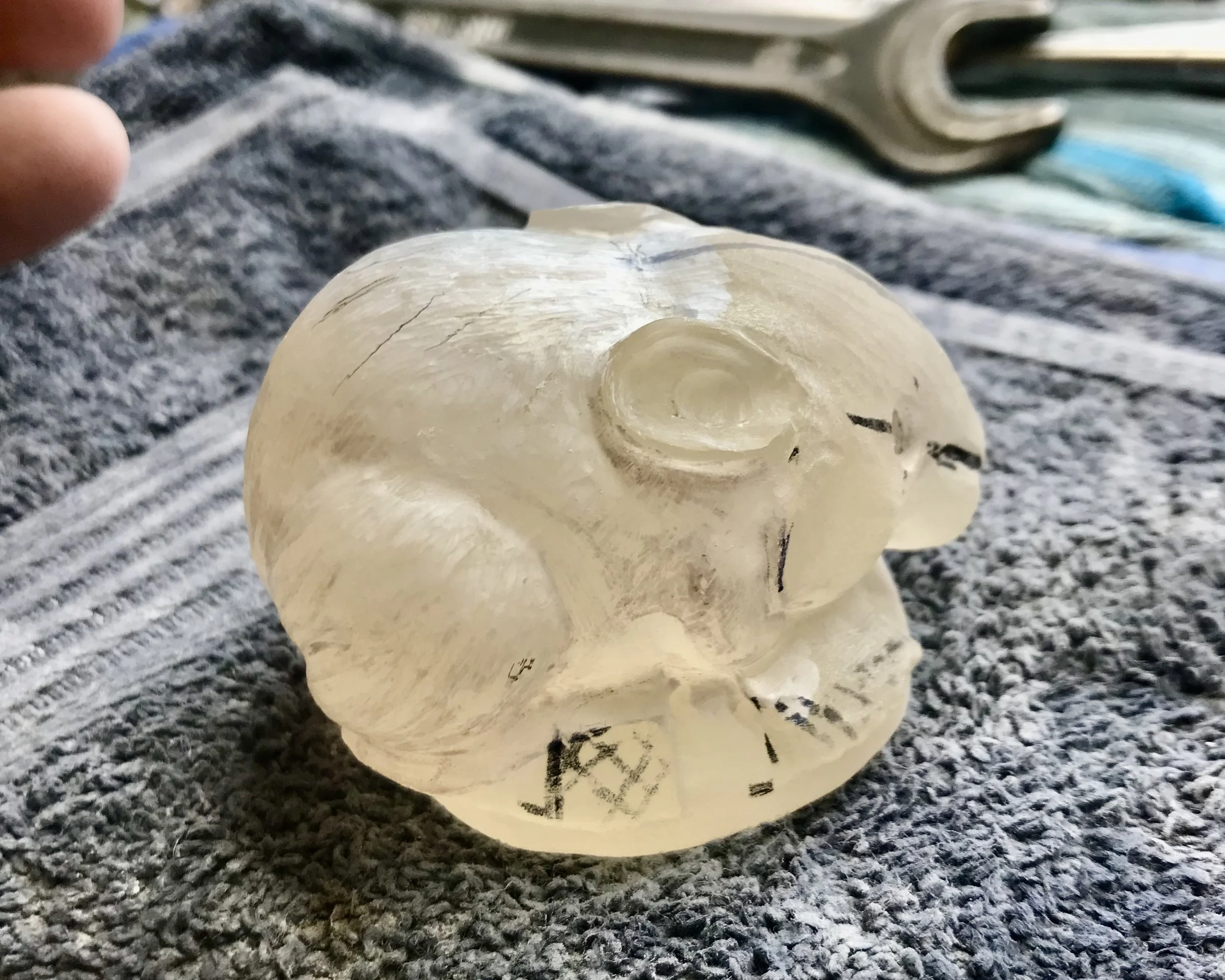
Further along the preforming process
What we see in a Dreher carving is not just 100 to 600 working hours per piece. What you see is generations of one family dedicated to becoming better than the last. What you see are self-taught techniques perfected over many decades of training to create lifelike animals down to the smallest details. What you see in Patrick’s work is the constant evolution over centuries of one family's undying passion for gemstone carving. I think that is why Patrick doesn’t just look at each carving as another sale, but rather a piece of himself released into the world. If Patrick hears that his carvings are being handled carelessly to the point they could get damaged easily, it might break his heart a little.
Living up to the Dreher name is a centuries old tradition. Before the Declaration of Independence was even a thought, this family has been working on agates and other hard stones, perfecting their craft ever since. This kind of family legacy is rare. With the advent of sintered diamond tools in the 1980’s, the Dreher families’ work evolved into something unimaginable just one generation prior. Now with decades of experimentation and practice using sintered diamond tools adapted to gemstone carving, Patrick has surpassed his father and grandfathers in technical skill and detail carrying the Dreher legacy to new heights.
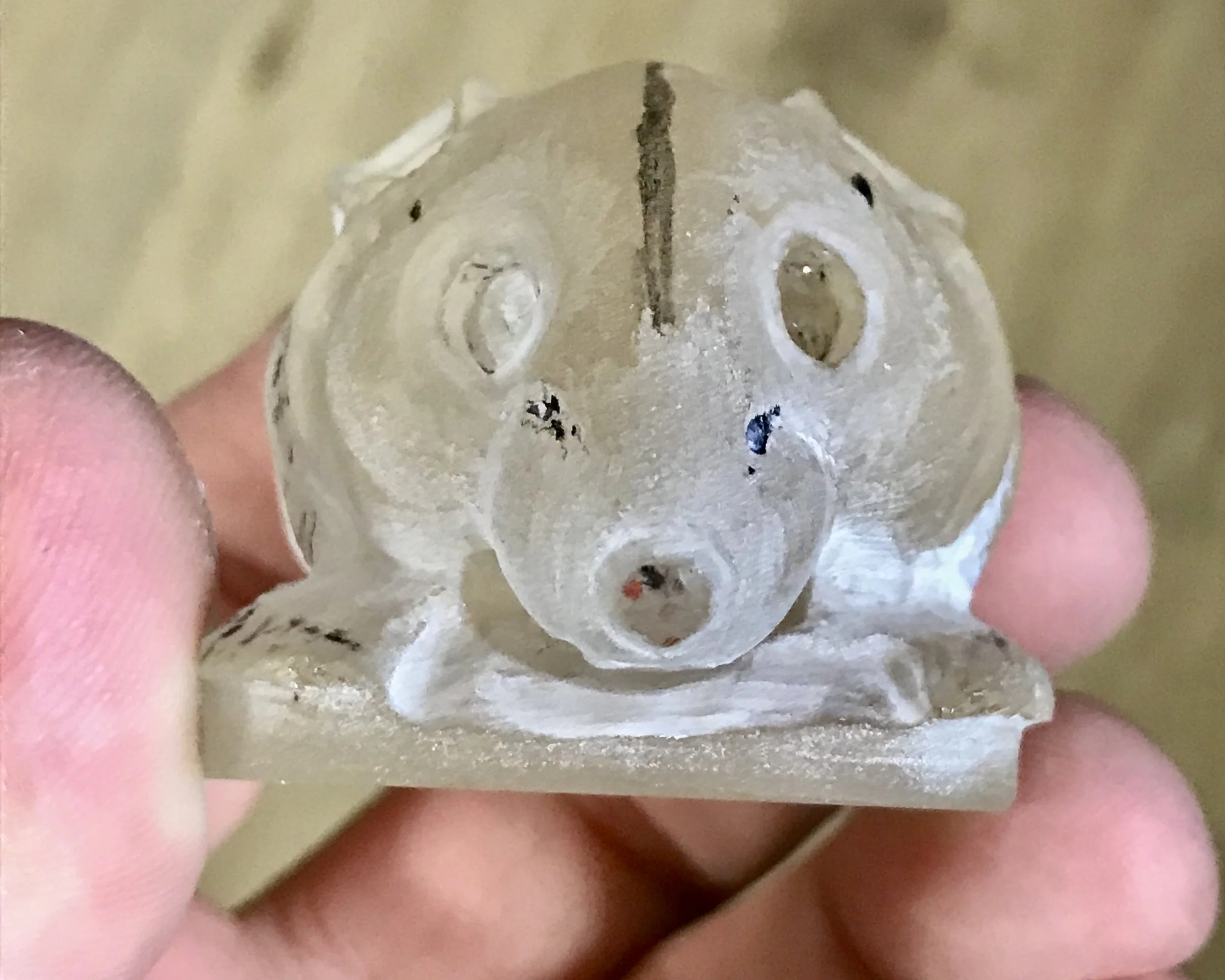
A face has appeared!
Through his worldwide, sold-out talks about his craft, he has taken the Dreher legacy to the forefront of public awareness and exposure. Gone are the days when people like Carl Faberge take credit for his family’s masterpieces. Amongst all this success, I think the best thing about Patrick is how quick he is to credit the platform his father and grandfathers built for him to learn and build upon. If you ask Patrick who is the greatest carver of all time he says Gerd Dreher, his father. This level of humility is something we can all learn from. Even without competition, now that Patrick’s father Gerd has passed away RIP, the constant evolution of Patrick’s work makes him better every year. Despite having a long wait list and many dedicated fans eager to buy the carvings he is currently producing, he still has the attitude of “how do you know next year will be the same?” I think this mindset is why every single piece that comes out of his workshop is better than the last!
This constant evolution of skills by each generation enabled the Drehers to become the family legacy they are today. The tools, sequences, and techniques Patrick and his family figured out over the decades to create these carvings had me saying hundreds of times in my head how genius they are. All from trial and error, through all the adversity they figured out how to create such minute, intricate, lifelike details and movement in hard stone. The ultra realistic details are what sets them apart from all others.
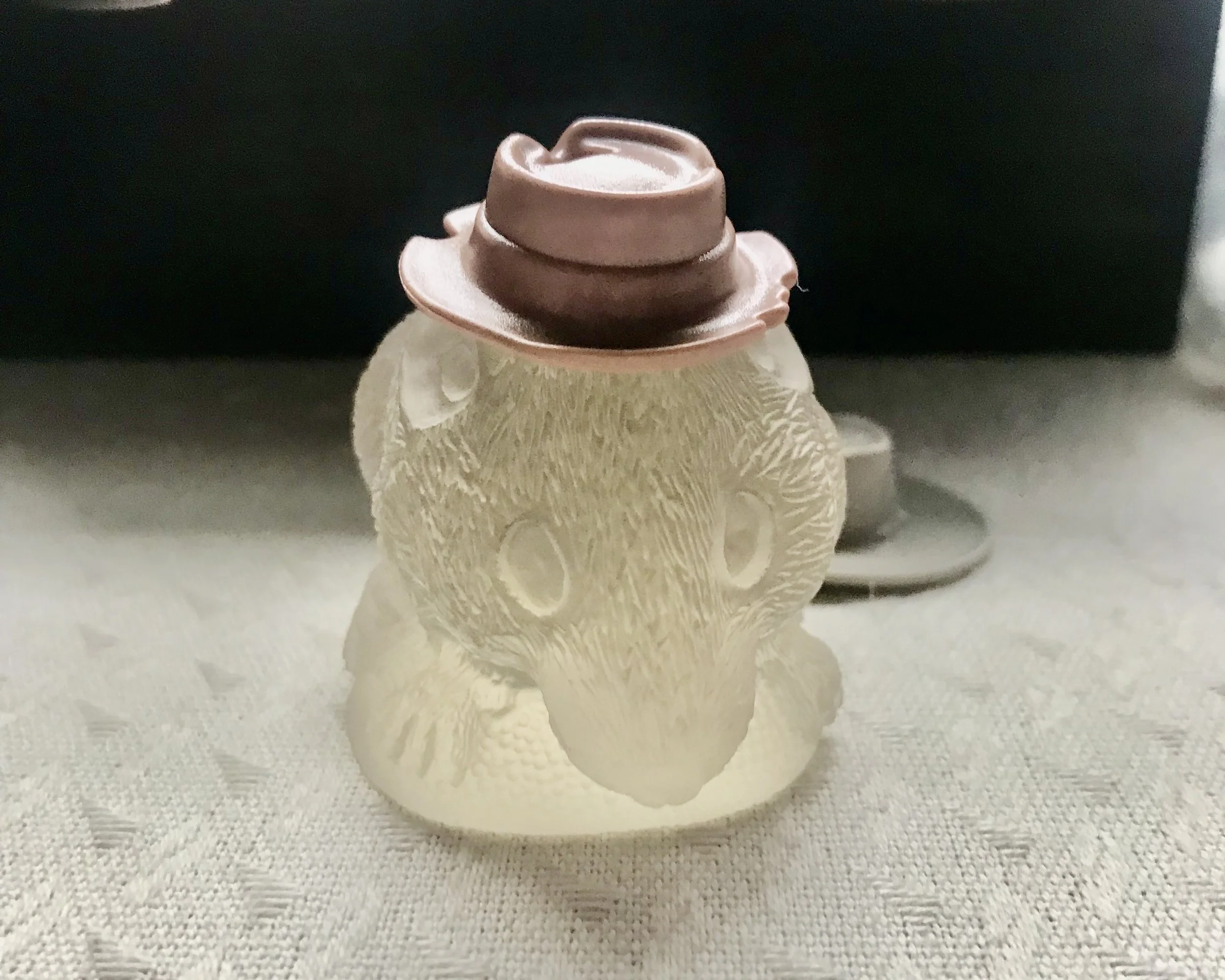
Having a little fun- test fitting his new cowboy hat
To achieve this type of perfection you can never be rushed. The amount of time and patience a Dreher carving takes is on another level, especially compared to my lapidary work. I can cut a 6.5mm round stone start to finish in under an hour. Most stones I cut take me less than 4 hours to complete. In an 8-hour workday, depending on the size of stones, I can get anywhere from 2 or 3 bigger stones done or something like 6-8 smaller stones finished. At the end of my day, I can see the fruits of the labor and calculate how much I can make selling the stones. It can give you instant gratification for the day’s work.
On the flip side, it takes Patrick a minimum 80 hours for the smallest carving like a mouse, and sometimes he will put in 500+ working hours into one carving before it’s finished. That’s not including the hours spent planning the carving and studying the rock. Even if you work like he does all day everyday it takes months to complete something of this proportion. Most people don’t have the mental fortitude and discipline it takes to be self-employed and stay on top of a project like this, even if they have the necessary skills to complete the job. This Is something I admire Patrick for, his work ethic and abilities as a businessman while also operating as a top-notch artist. Some people can’t do both.
Living up to this kind of family pressure to become a master must not have been easy working under your father, so I can only imagine how many times Patrick wanted to quit. One factor to consider as a fan of his work is how lucky we are that Patrick didn’t stray to other passions. As a collector or lover of Dreher carvings... Can you imagine a world without new Dreher carvings every year? For me it’s a hard pass and a reality I never want to imagine. If you ask him, he had many other passions he could have pursued as a young man but ultimately chose to carry on the family legacy.
The world is blessed to be witnessing his works of art as it took decades of dedication and sacrifice to get to his level. Truth is not many people know the sacrifice and dedication it took to become who Patrick Dreher is. Just one instance, imagine being offered at 19 years old a summer job in the Maldives for 5k per month (and we’re talking 5k in the 80’s so a bit more today) to be a scuba diving instructor. Sounds cool, right? If I was qualified for the position, you can bet your life savings I would have taken the opportunity. Yet Patrick declined this offer because his father needed his help working to stay on time with the current orders they had. I cannot say I would have done the same thing and made such selfless sacrifice at that young age. It is sacrifice and dedication like this that led Patrick to becoming the greatest of all time and producing the finest gemstone carvings mankind has ever seen.
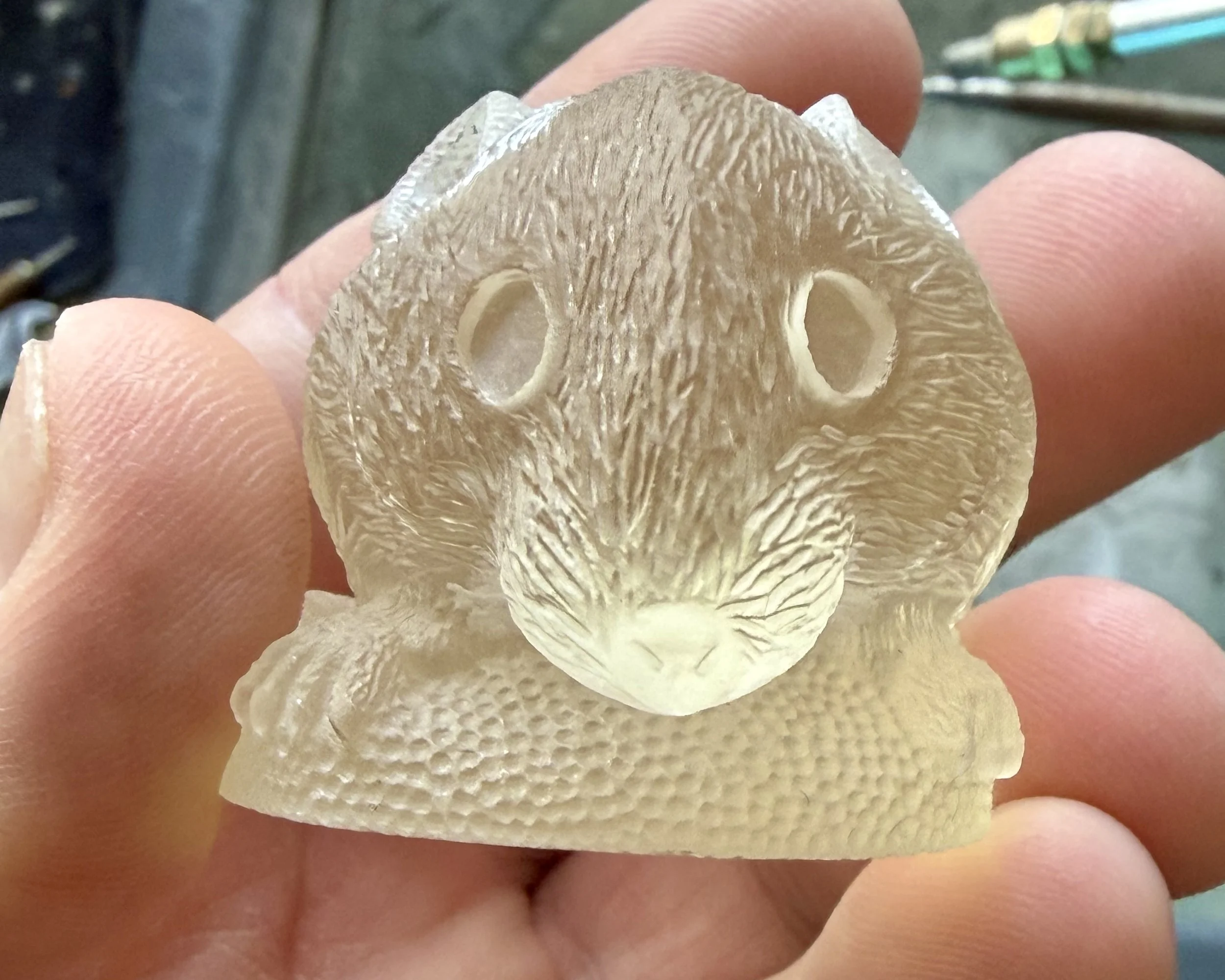
The feet are in place and the carving of fur has begun
So back to the number of working hours per piece subject. It’s a question so often asked that Patrick will put the information right on the ID card with the price in his gallery. In my opinion, it’s the easiest way for people to determine the value by how many man hours were invested plus the cost of the rough and materials but in my opinion, this is the wrong way to go about determining value on an object this rare.
When you are one of the lucky few to be next on Patrick’s waiting list, I urge you to think of your investment in this manner. You’re paying for the years not the hours, just like the famous Picasso anecdote. To me it seems strange to value these masterpieces by how many man hours it took to create plus the cost of the rough and materials because it didn’t take Patrick 1-500+ hours per piece to create them. It took him his entire life to be able to create this carving in 1-500+ hours. The point that is most often missed in this conversation is that you or I can have an infinite number of hours and we still could not carve at the same level Patrick can. With this supply and demand equation of nobody else being able to supply such artworks coupled with the demand of his work on the market he could charge whatever he wanted yet he stays grounded and loyal to his collectors.
At the rate Patrick sells his carvings for, Dreher carvings are an extremely good value, dare I say inexpensive for what you are getting. Don’t believe me? Just find one of his carvings on the resale market and compare to his gallery pricing… When I look at Patrick’s work and the prices, a famous line always comes to mind used by a legend in the lapidary community and may he now rest in peace Bill Vance. When someone thought a stone was too expensive, his response was “go get another one!” Luckily Bill and his wife Elke sell some of the rarest cut gemstones and he absolutely can say this while not budging on his price in certain cases.
Then you have Patrick’s carvings, which are on another level of rarity from this I believe considering no one on earth can carve like him. He has less than 200 carvings coming out of his career left and every year his wait list gets longer making the demand heavily outweigh the supply. Even if some think his production numbers are low per year, having seen how much time and dedication goes into each masterpiece firsthand, it gives me an entirely new respect for the number of carvings he is able to produce each year. Let’s also take a moment to thank Kristiane for EVERYTHING she does in this operation allowing Patrick to focus more of his time on what he does best!
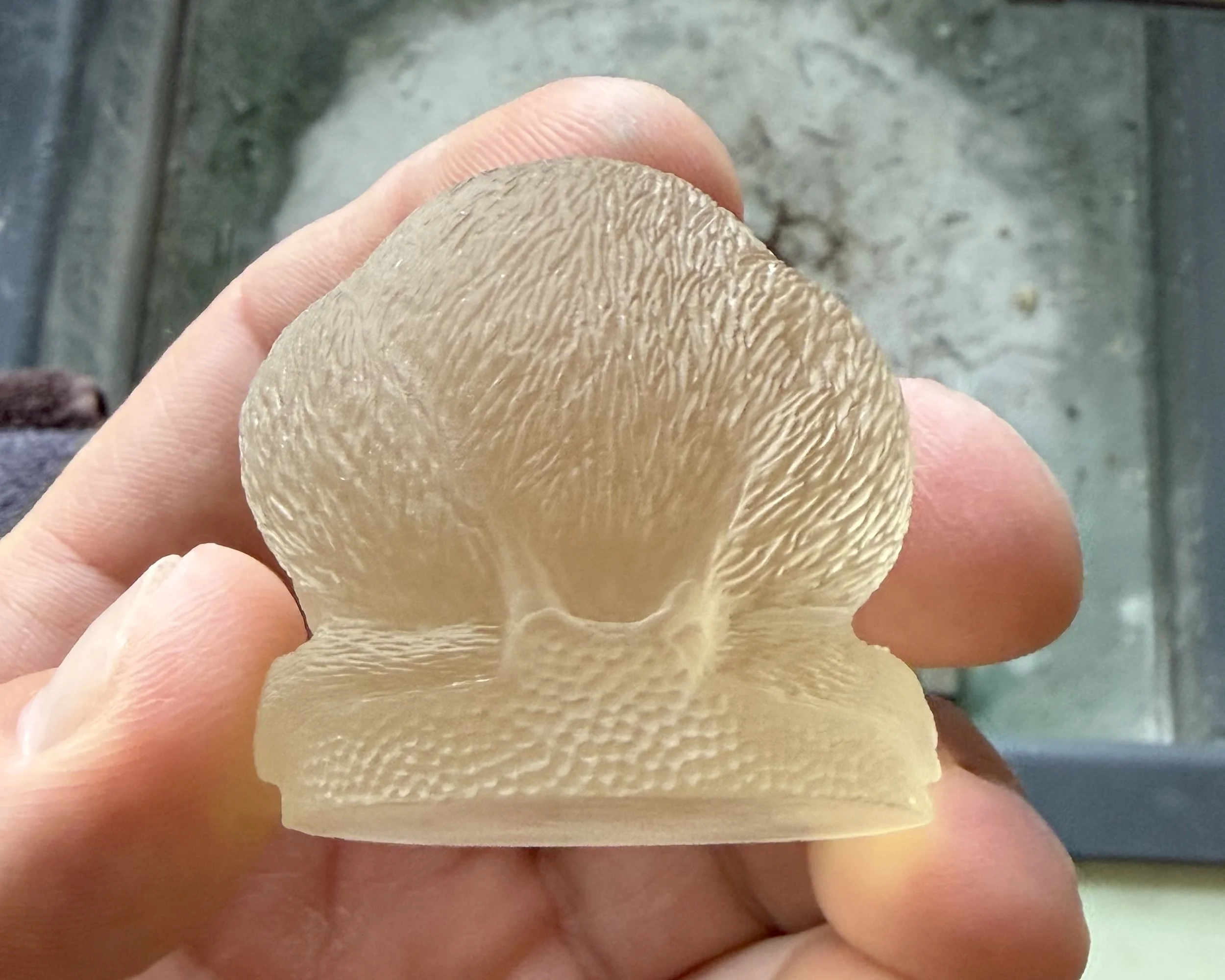
Backside fur carving
I never counted but an extremely conservative estimate on the mouse I carved has taken me over 400 hours and it’s nothing like the quality of Patrick’s work. I stopped counting at 50 differences between my mouse and what Patrick would do. Now I don’t want people to think I’m disappointed in my first attempt! It looks great for my first carving thanks to Patrick always bailing me out when I needed help. I’m simply pointing out the mastery at hand when the wizard steps to his carving station.
Have you ever seen a mouse by Patrick or any animal for that matter with fur that is going in the wrong direction, uneven in depth, uneven in thickness, varying lengths of each cut making some of the hairs small and some too long, eyes that are oval when they’re supposed to be round, eyes that are slightly different in size, ears that are slightly different in size, ears that have different degree of curve, ears that have different thickness from each other, ears that have different height, legs that are slightly different in length, the back thighs being different thickness, the back left leg is sitting higher than the right, the toenails are not all the same length or depth, the back feet don’t exactly line up, the cheeks on its face are slightly different sizes, the teeth are carved slightly crooked, and the list can go on and on.
Despite my carving looking good from an arm’s length, it has every single one of these issues present. While this is to be expected and does not disappoint me in any way as I will do better on the next carving, it highlights just how masterful Patrick’s work is. Not a single flaw would ever be present in his work and that’s what sets his masterpieces apart as the greatest ever. Hands down Dreher carvings display the highest degree of technical craftsmanship and anatomical accuracy the gemstone community has ever seen.
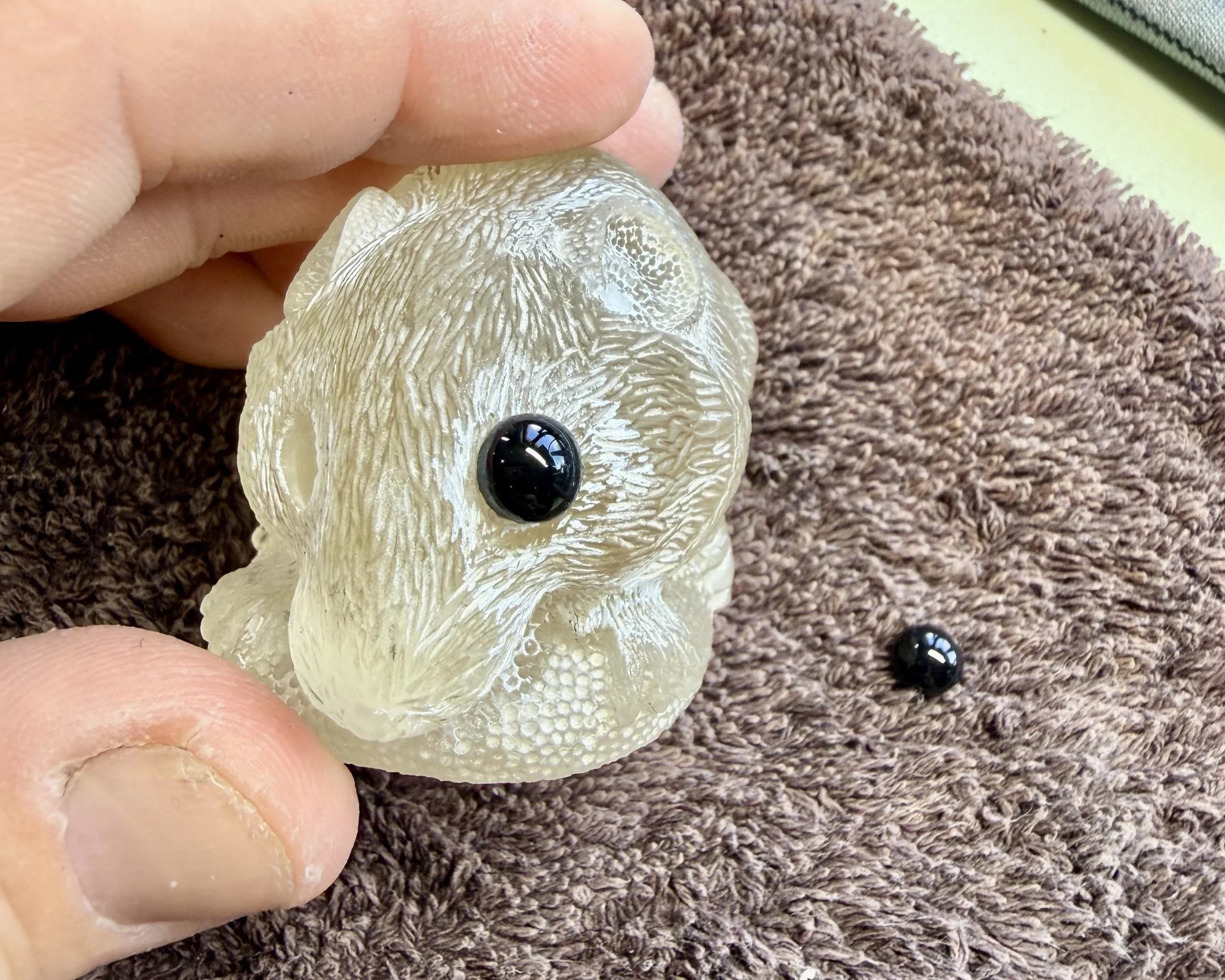
Test fitting the eyes before making them oval shaped to fit the hole
You could try to carve one yourself to see how truly good he is or you can just take my word for it! Still, trying to express into words how good he is can be difficult for me. When you are a beginner, you must practice the techniques a lot on scrap pieces before moving to the working piece. On a mouse for instance, before you create the body, legs, feet, eye holes, mouth etc.… on the actual mouse you’re practicing techniques for hours and sometimes days on practice pieces of quartz. Carving the fur would literally have been impossible for me without Patrick’s amazing instruction. I practiced for three weeks or more just failing at carving fur until I finally started to just slightly get the techniques down and it looks like a 6-year-old carved it instead of a toddler.
I had more than a few thoughts about quitting during this learning curve because I felt so defeated. Like I said, It was on one of these days that I had the realization I don’t think there will ever be a better gemstone carver, and we are witnessing the G.O.A.T. live! Luckily for my sanity Patrick was always there to show me what I was doing wrong to get me closer to being on track. Now imagine being the trailblazer rather than having the master show you how it’s done. It’s amazing the Drehers persisted through generations of adversity to get to this level being self-taught.
When I first asked Patrick the number of working hours per piece question, I genuinely thought how is that possible? I would never spend that much time per piece as a lapidary, so the concept seemed a bit foreign to me. After completing a small mouse carving in 400+ hours I truly believe his estimates are beyond conservative and he spends more hours than he claims on every piece. Now imagine If Patrick worked at my pace but still achieved his level of perfection. He would have to charge a lot more for his masterpieces. Luckily for collectors of his work, he is a master of his craft in every way imaginable hence his carvings are sold at a tremendous value.
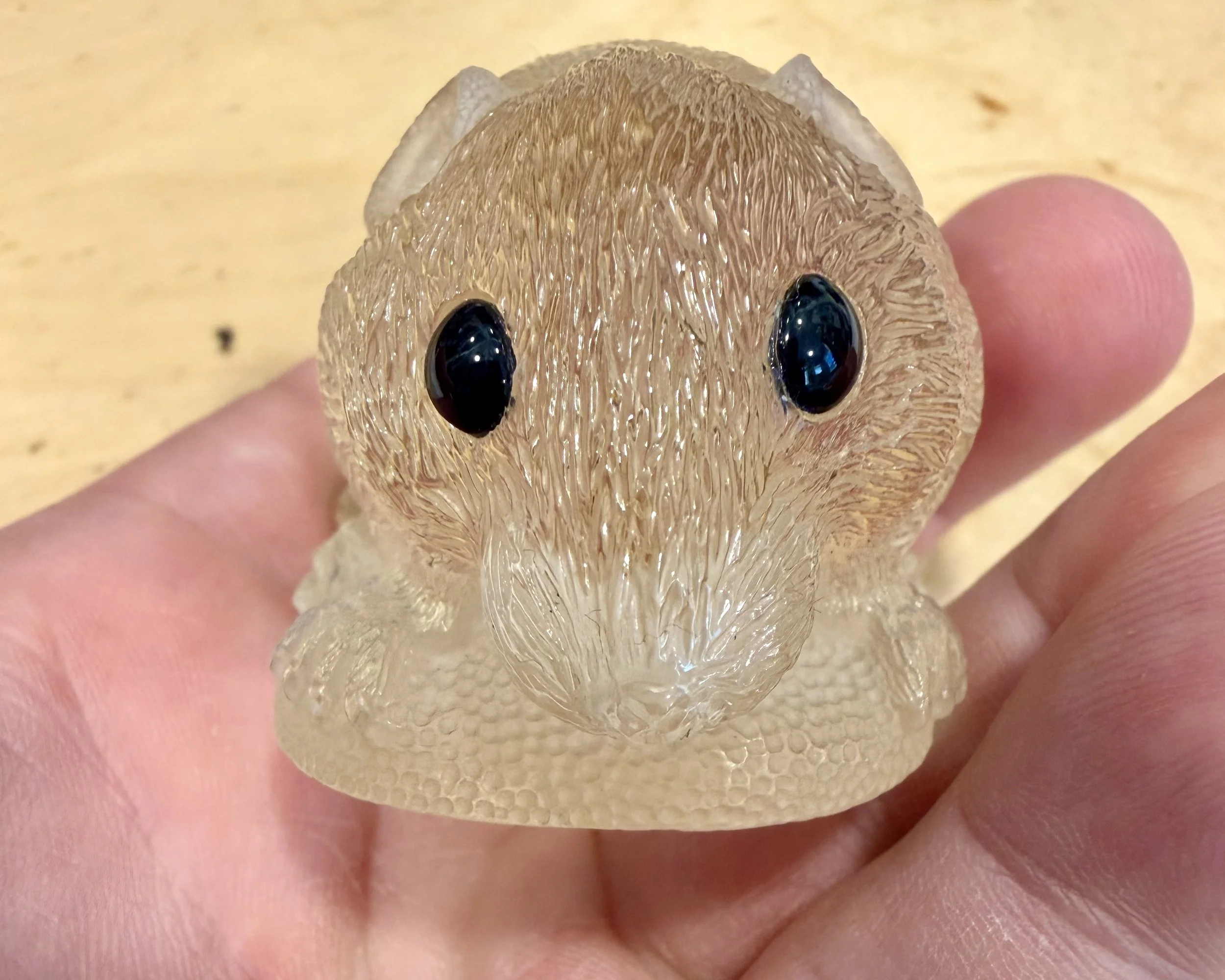
Both eyes fit now!
Using the working hours plus materials cost to determine value I think is a lot like buying mineral specimens by weight. For instance, asking how many grams a tourmaline crystal weighs as a price determination is something I have seen on the market when shopping at shows. Maybe people can gauge if the tourmaline is $100 per gram or less, it’s a fair price, but this leaves out the most important factors when buying mineral specimens. A more seasoned and educated collector will be looking for quality factors such as overall aesthetics, saturation of color, is the specimen damage and repair free, among other things that are important factors to the value.
Trying to price Patrick’s carvings by how many working hours are in the piece to determine the value I think is the wrong way to look at these masterpieces considering no one else can achieve what he can. Also like I mentioned, this equation does not account for the planning time, which can be an extensive number of hours. Regardless of opinion on the matter, the fact remains they are only going to skyrocket in value through the years, especially when he retires.
Another reason I say he could charge a lot more is think about how many professionals you employ in a regular year of life that cost more. Plumbers, electricians, mechanics, some hair stylists, doctors, lawyers and the list can go on. Now think about how many people work in those fields. Finding a lawyer or plumber is not rare. Now list how many people can do what Patrick does, just him. The conclusion you should come to is he could charge any price he wanted.
This is why I say his carvings are of tremendous value compared to what he sells them for. Yet at this peak of success, he stays grounded and says he doesn’t want to become inaccessible to the collectors and followers that enabled him over the years to raise the Dreher legacy to what it is today. The true people that have always supported his artwork. This is one of his greatest qualities as a human, his loyalty and overall genuine caring attitude towards his friends. When there is only one Patrick in the world it puts into perspective how good of value his carvings are.
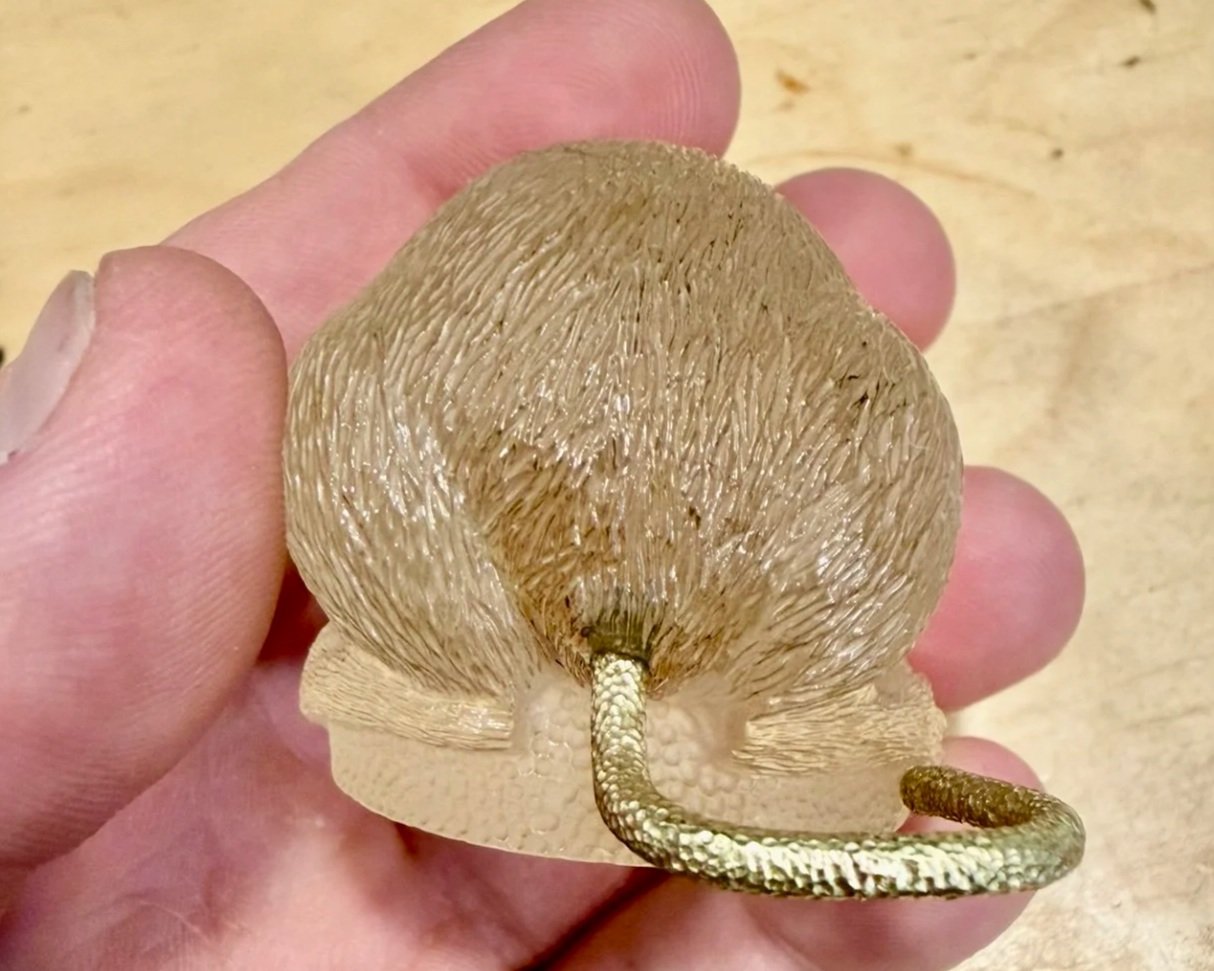
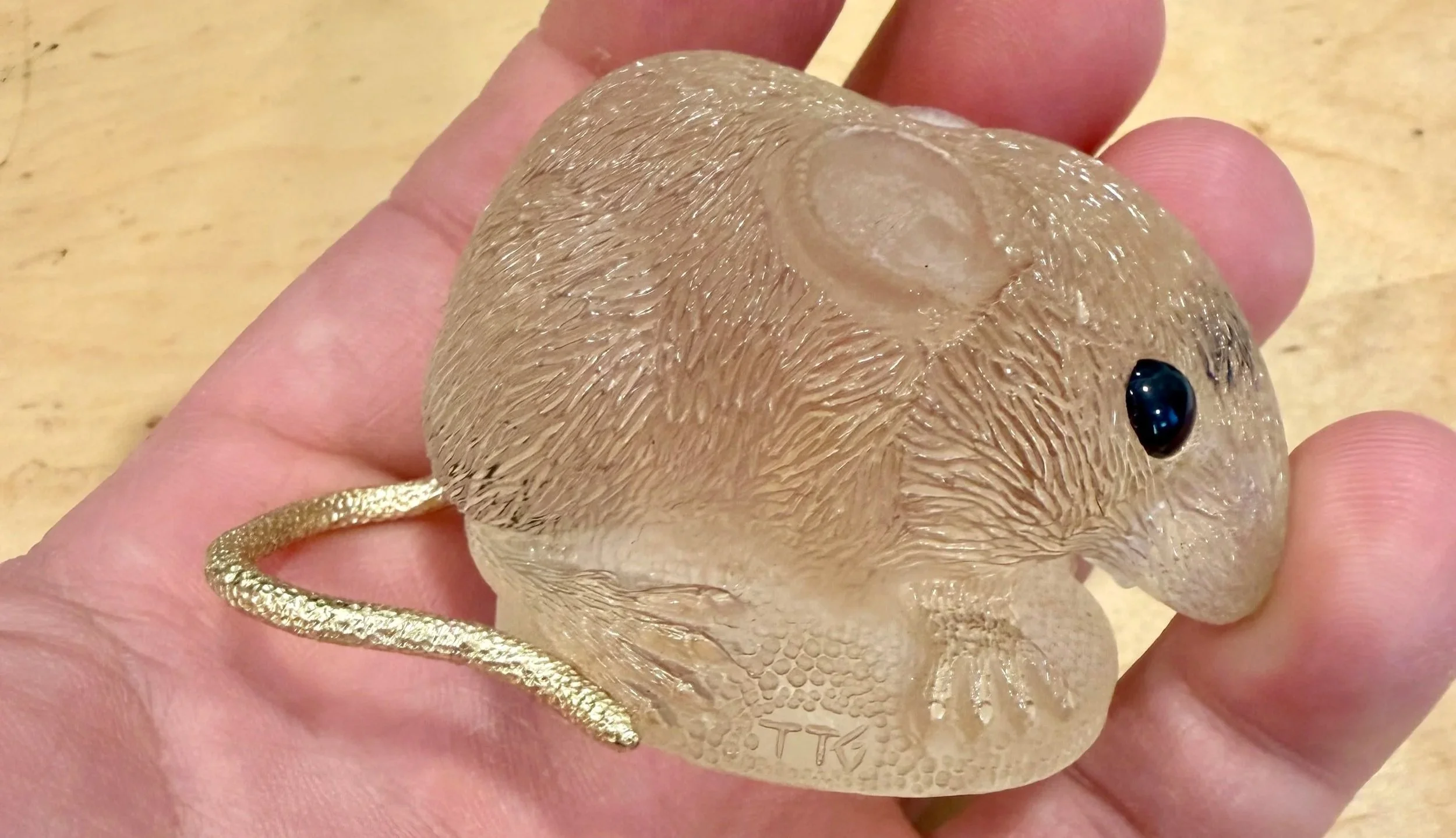
Showing off his 18k yellow gold tail!
Now let’s put into perspective how rare a Dreher carving is. Excluding the agate bowl days, when it comes to what we know the work of the Dreher family to be, the entire Dreher family through the generations will produce maybe 1,000 animal carvings. You break this down amongst generations and you realize you get around 3-400 carvings in a lifetime from one master at the very best. So, let’s say Patrick produces even 400 carvings in his lifetime to be conservative. There are 8 billion people on this planet, and you have a chance to be 1 of 400 people who own a Patrick Dreher carving. Then you must consider that most collectors own more than one Dreher carving and now you can imagine how truly small this group becomes. That means you have a .0000048% chance or less of being one of the lucky ones that gets to own a piece of lapidary history. It’s like winning the lottery with odds stacked so high.
With such limited availability, it’s amazing his collectors at every Tucson show are able to view and purchase his latest masterpieces directly from Patrick. If you have seen his work on the resale market from other dealers you know the prices they achieve. What Patrick offers is like buying at factory direct pricing from the most famous and limited gemstone carver in the world! I could justify the importance, value, and rarity of a Dreher carving all day but in the end, if it brings you joy it was worth every penny!
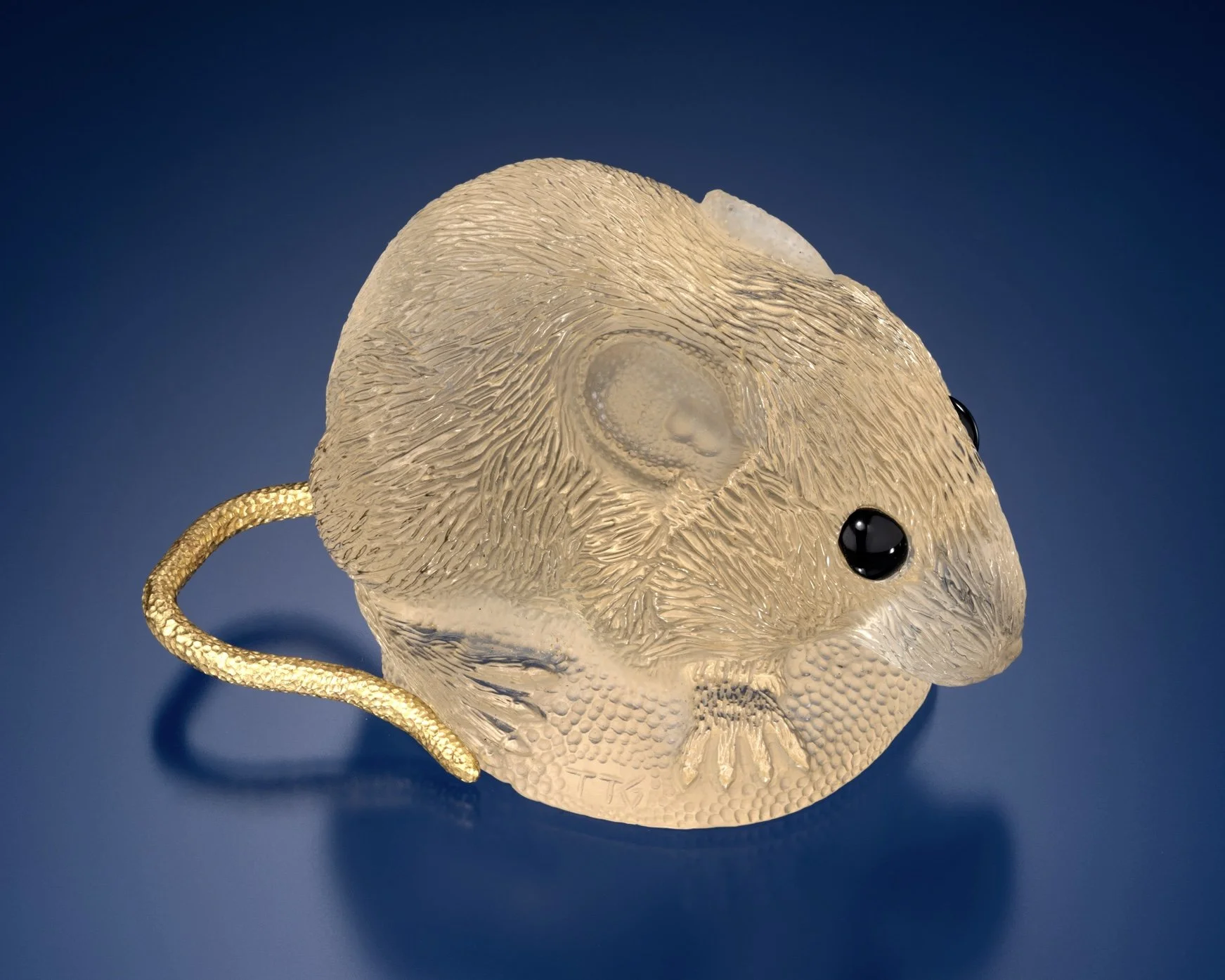
Meet Mr. Whiskers! All finished and polished! Photo credit Robert Weldon.
Learning gemstone carving from Patrick along with being ½ of the team responsible for GARANATUS: From Rough to Cut have been the highest honors of my career. What I have learned so far and will continue to learn from Patrick is something I will never take for granted as I embark on this carving journey. The importance of the gift he has given me cannot be understated. I can only hope that someday through the same practice and dedication, my carvings will be able to impress the gemstone community.
First and foremost, I will always consider myself a crystal machinist (gemstone cutter) as that’s how I pay the bills, but I’m very excited to explore how I can adapt all these techniques I’m learning into new applications. Pairing my abilities and ideas with Mary’s award winning designs and craftsmanship I know we can bring some amazing new creations to the world soon! The possibilities are endless now and it’s up to us to come up with our own ideas as I will never bite the hand that feeds me and try to copy Patrick’s work. Animals are his expertise and I will find my own way as an artist with his guidance.
Thanks for reading and hope to see y’all at the Dreher gallery next Tucson show!
Aufweidersehen for now,
Todd Wacks